Debt Is Costing You More Than Money
It’s costing your time, freedom, and choices.
Method Debt Elimination System
The first and only web-based debt elimination and wealth creation advanced dynamic financial technology designed to show you the fastest, most efficient path to zero debt—and guide you every step of the way. This isn’t theory. This is precision.
We demonstrate exactly how to eliminate debt rapidly and strategically, including mortgages, auto loans, student loans, credit cards, and all forms of consumer debt using a system engineered to optimize every dollar. At the core is the Money Max Account™, an automated banking algorithm that gives everyday individuals access to the same financial principles and strategies traditionally used by banks.
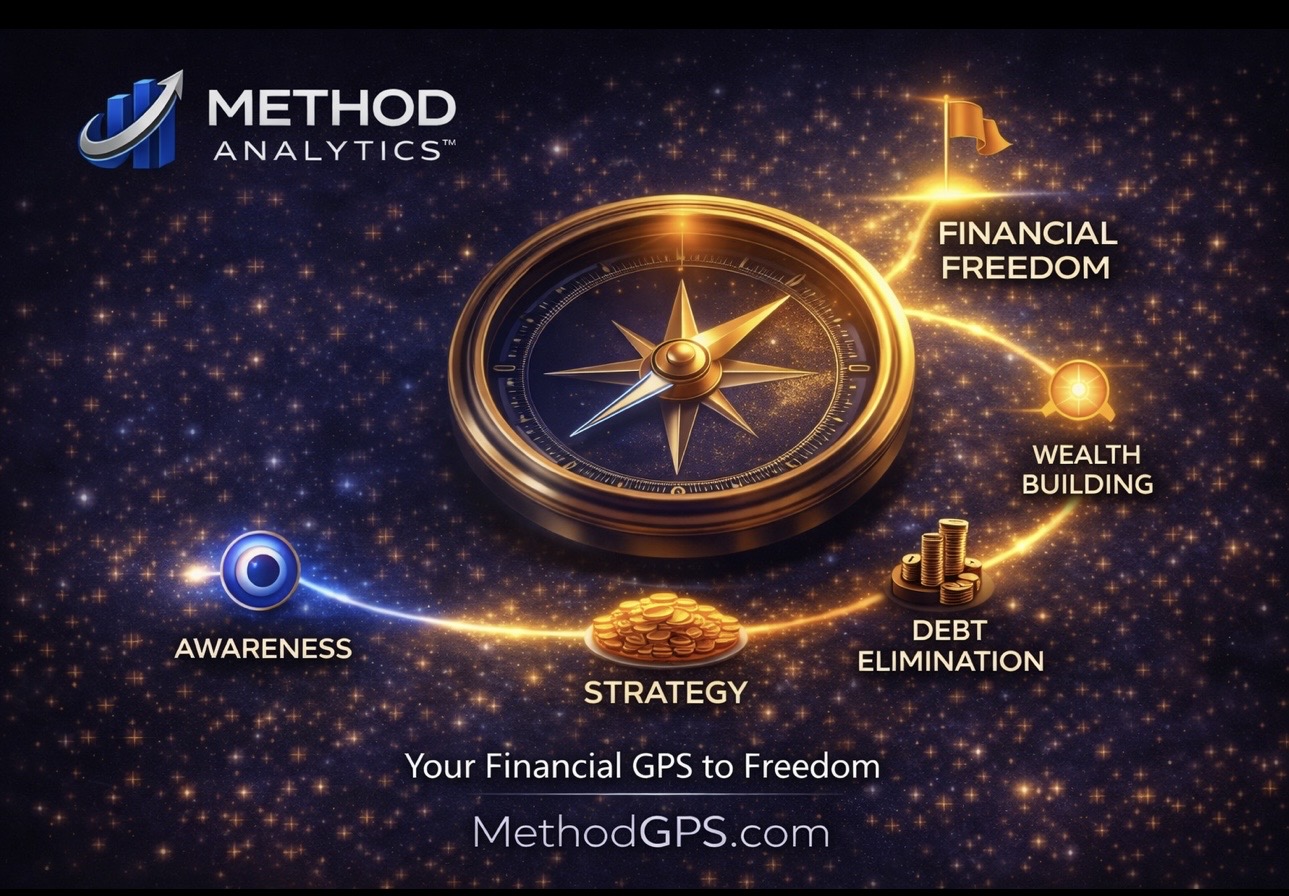
It’s like having your own Financial GPS. Just as a GPS guides you to your destination using the most efficient route—adjusting in real time as conditions change—this system continuously recalculates to keep you on the optimal path to financial freedom. Through our Free Personal Savings Report, you’ll see exactly when you can be debt-free—down to the month and year—and how to get there. No guessing. A clear, defined path forward, backed by a system designed to perform and a process built to stand behind the outcome. Everything dynamically adjusts in real time, giving you full visibility into where you are, where you’re going, and how to stay on course even as life happens.
We don’t just explain concepts—we demonstrate real-world outcomes. In real time, you see how to accelerate debt elimination while simultaneously building wealth, guided by a system that continuously recalculates to keep you aligned with your desired outcome. In essence, we teach you how to use the same dollar twice—eliminating debt while creating wealth at the same time.
Engineered. Precise. Dynamic. Proven.
THE ORIGIN OF THE WORD “MORTGAGE”
Understanding What It Really Means
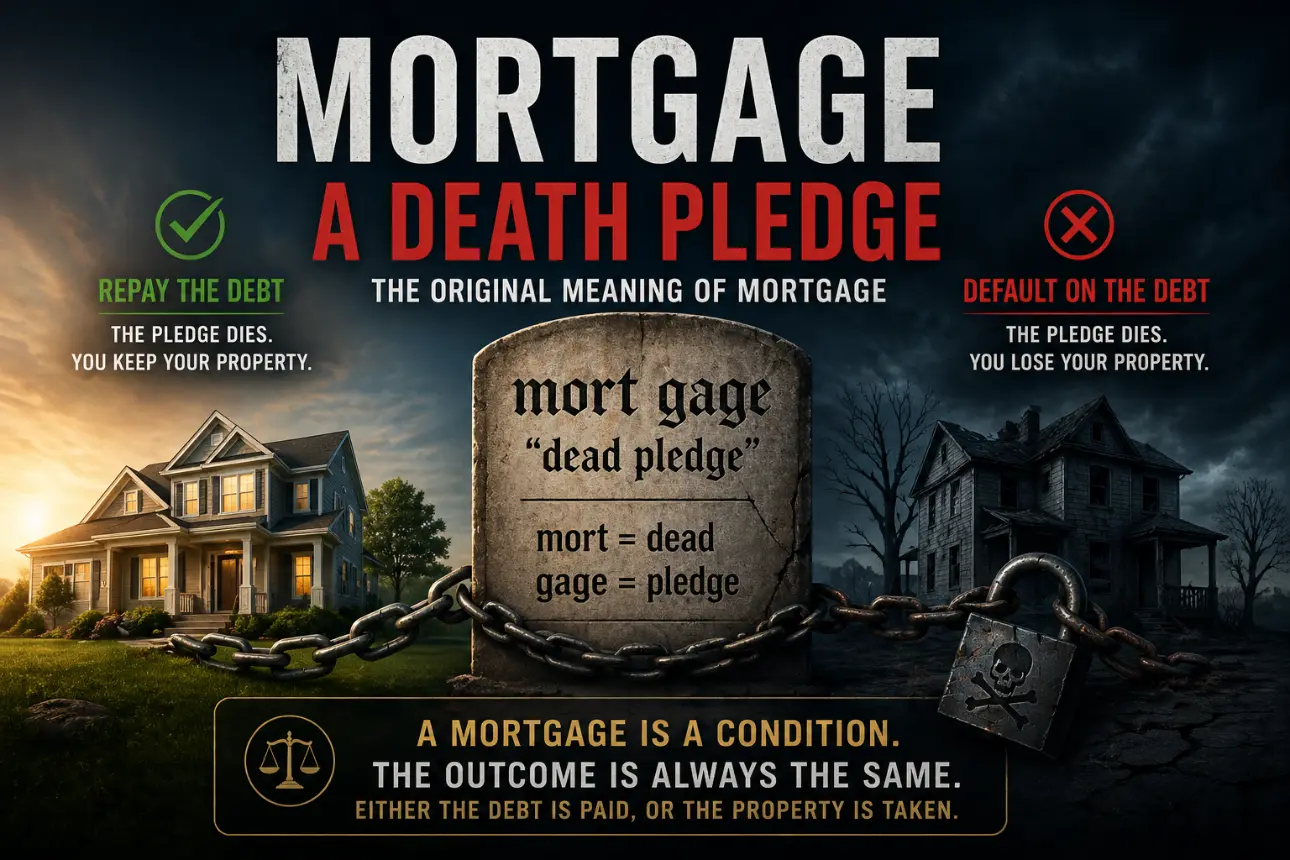
The word mortgage traces back to the Latin word mortuus, meaning dead. Over time, this evolved through Old French into mort gage—literally translated as “dead pledge.” That definition wasn’t symbolic. It was precise.
A mortgage was designed as a conditional agreement—one that would ultimately reach a final, irreversible outcome. The pledge, which is the property itself, becomes “dead” under one of two conditions: either the debt is fully repaid and the obligation is extinguished, or the borrower fails to meet the terms and the property is taken. In either case, the pledge no longer exists in its original form. It is, by definition, finished.
This concept is not modern. The idea of securing a debt with property dates back thousands of years to ancient Greece and Rome, where early forms of collateralized lending—such as the hypotheca—allowed borrowers to retain possession of their property while it stood as security for a loan. Over time, these principles moved through medieval Europe and became formalized in English common law, where the structure of the modern mortgage began to take shape.
By the 14th century in England, the term mortgage was firmly established, and its meaning was clear. The land was conditionally pledged to the lender. If the borrower fulfilled the obligation, the pledge dissolved. If not, the lender had the legal right to claim the property. The agreement was absolute, and the outcome was final.
While the language may feel archaic, the structure remains largely unchanged today.
A mortgage is still a conditional contract. The borrower occupies and uses the property, but the lender retains a secured interest until the debt is satisfied. Ownership, in practical terms, is not fully realized until that obligation is completely removed. The word itself tells the story.
A mortgage was never simply about acquiring property—it was about entering into an agreement where the outcome is predetermined by the structure of the debt. Understanding that origin isn’t just historical context. It’s clarity. And clarity is where control begins.