Debt Crisis in America
DEBT CRISIS IN AMERICA
Financial Pressure Breaking Families

The Reality
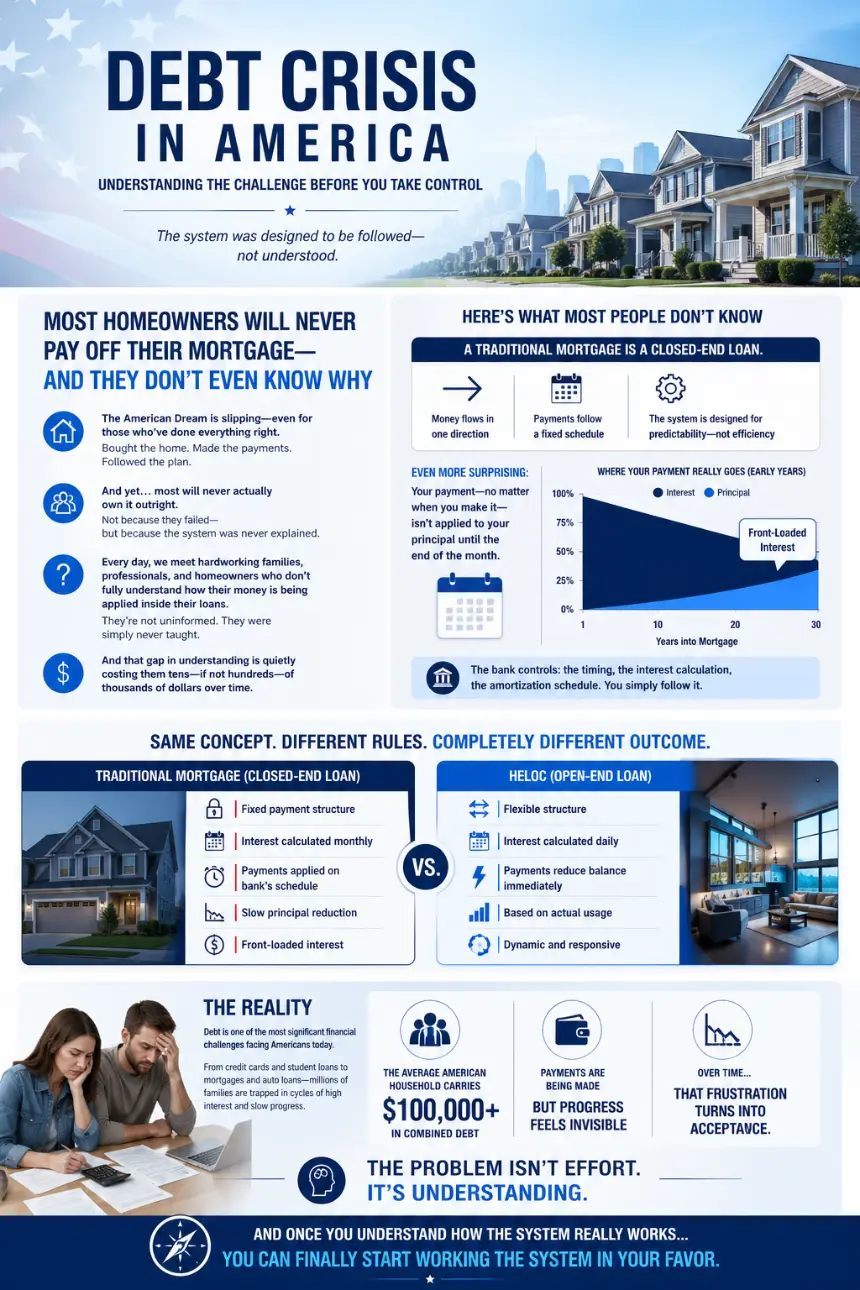
THE REALITY Debt is one of the most significant financial challenges facing Americans today. From credit cards and student loans to mortgages and auto loans, millions of families are trapped in cycles of high interest and slow progress. The average American household carries over $100,000 in combined debt and many feel powerless to change it. But the problem isn’t a lack of effort. It’s a lack of understanding.
Most of us are doing exactly what they’ve been told to do. We make payments on time, follow the plan and believe that consistency alone will eventually lead us to financial freedom. And yet, year after year, the balances barely seem to move. Progress feels slow, and in many cases, nonexistent.
That’s not by accident. The financial system is structured in a way that prioritizes time and interest over speed and efficiency. Payments are applied in a manner that benefits the lender first, not the borrower. Interest is heavily front-loaded, meaning in the early years of a loan, the majority of each payment goes toward interest rather than reducing the principal balance. The result is a system where people can stay committed, stay disciplined, and still lose decades of TIME and TIME is the most valuable asset we have.
What most don’t realize is that the traditional approach to managing money is static in a dynamic world. Budgets, spreadsheets, and long-term projections assume that life will go exactly as planned. But life doesn’t work that way. Income changes. Expenses arise. Opportunities come and go. Without a system that adapts in real time, even the best intentions begin to fall apart.
So people compensate the only way they know how they work harder. They try to earn more, cut back more, sacrifice more. But effort without direction only leads to frustration. Because the issue was never just the debt itself… it was the structure behind it.
Until someone understands how money actually flows how interest accumulates, how timing impacts outcomes, and how small adjustments can create massive shifts they remain stuck in a cycle that feels impossible to break.
This is the reality. Not that people are failing. But that they were never shown a better way.